



Your voice decides what gets published.
GlobalX Publications connects academic voices worldwide through credible publishing, expert insights, and global research visibility.
GlobalX Publications
Dr. Philip J. Kranzusch has been awarded the 2026 NAS Award in Molecular Biology for pioneering discoveries in innate immunity, antiviral defense mechanisms, molecular immunology, and evolutionary biology.
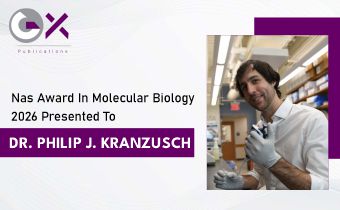
Awarding the 2026 NAS Award in Molecular Biology, Dr. Philip J. Kranzusch associated with Dana-Farber Cancer Institute and Harvard Medical School for his groundbreaking findings in molecular immunology and antiviral defense strategies will be honored. The award recognizes recent significant accomplishment in molecular biology, made by an exceptionally promising scientist who has widened the frontiers of biological sciences.
Dr. Kranzusch is widely viewed as one of the most exciting young scientists in innate immunity today, having changed the scientific story of how cells sense and respond to viruses while revealing profound evolutionary links between the bacterial immune system and that of humans.
Dr. kranzusch was recognized for his groundbreaking work elucidating the evolution of key elements of human innate immunity from ancient antivirus functions invented by bacteria billions years ago. His findings are helping to revolutionize scientists' understanding of the evolution of the immune system, as well as the molecular mechanisms that enable organisms to defend against infection.
A sequence of pivotal studies showed that important pathways associated with many aspects of human immune response, including systems targeted by vaccines and cancer immunotherapies, derive from mechanisms that bacteria employ to defend themselves against viruses. This was a direct challenge to several long-held beliefs in biology and led to entirely new areas of research straddling microbio-logy, immunology, and evolutionary biology.
Some of Dr. Kranzusch great contributions have been deciphering the molecular link between bacterial antiviral systems and contemporary human immune signaling pathways. His research showed that also mechanisms used by bacteria to defend themselves against viral infection may arise as evolutionary precursors of elements in the human immune system.
The insights from these discoveries not only have deepened understanding of the evolution of immunity over billions of years through various life forms. His lab has provided insight into the molecular basis of how human cells recognize pathogens, initiate immune responses, and fight infection and disease by studying bacterial strategies for evading host defenses.
Outside the field of evolutionary biology, Dr.kranzusch studies have critical implications for human health and medicine in general. His research studies the mechanisms by which cells sense viral pathogens, and applies knowledge of innate immune signaling pathways for the development of novel therapeutic strategies to treat infectious diseases, cancer and autoimmunity.
He also revealed nucleotide- based immune signaling pathways that control responses of human cells to pathogens and cancer. These discoveries are aiding the identification of potential new therapeutic modalities and improving our understanding of immune system regulation. The researchers suggest that the discovery might enable them to develop vaccines, immunotherapies and rationalized therapies for a variety of diseases.
Throughout his career, he has achieved acclaimed for multiple transformative discoveries in antiviral immunity, biochemistry ,structural biology and evolutionary biology.
He has received several honors from major scientific organizations and it is one of the most recognized innovators developing knowledge about host-pathogens interactions and immune defense systems. He showcased an interdisciplinary approach , linking multiple scientific disciplines together and inspiring new generations of researchers in the process.
The NAS Award in Molecular Biology 2026 is attributed to Dr. Philip J. Kranzusch (Harvard University, Boston), for a series of discoveries that have revolutionized the scientific community's understanding of immune defense and molecular evolution. The discoveries he has made are about how microbiology and immunology have changed to reveal unsuspected biological links that stretch back billions of years into the history of evolution.
With Dr. Kranzusch’s work providing a critical foundation for additional breakthroughs , scientists are actively looking to exploit these previously unknown vulnerabilities in the battle against infectious disease, cancer and immune disorders .It is a striking illustration of how science – pursued out of pure intellectual curiosity. Not immediately applicable impact or financial gain – can yield scientific discoveries that profoundly influence human health and medicine and our understanding of life