



Your voice decides what gets published.
GlobalX Publications connects academic voices worldwide through credible publishing, expert insights, and global research visibility.
GlobalX Publications
Benjamin R. Safdi has been awarded the 2026 New Horizons in Physics Prize for pioneering contributions to axion physics, dark matter research, cosmology, and innovative particle detection methods.
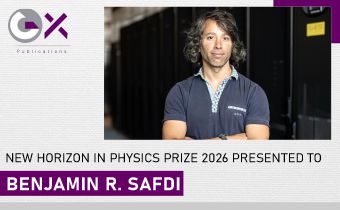
The Breakthrough Prize Foundation awarded Benjamin R. Safdi the 2026 New Horizons in Physics Prize.They commended him for his exceptional work on axions and dark matter, as well as his creative solutions to cosmological puzzles. He is now contributing significantly to physics along with other leading authorities in the subject. The award contributes to the outstanding accomplishments of these bright young brains discovering the principles of the cosmos.
Awarded for his groundbreaking work on axions and axion-like-particles — hypothetical particles that could partially solve two of the greatest problems in modern physics, those being dark matter and strong nuclear force. Theoretical and experimental endeavors to find these evanescent particles have received considerable help from his research work.
Known to account for about 85 percent of the mass in the universe, dark matter is mysterious material that folds into galaxies even though its nature hasn’t been determined as of yet. The topic of whether axions could be potential candidates for this elusive and cosmologically mysterious dark matter has been raised by new training in Safdi's research.
Safdi's getting acclaim mostly for his role in devising new methods to hunt down axion-like particles. He does this through lab experiments and looking at the sky. Safdi's work also hints at ways to spot these particles by studying signals from neutron stars and white dwarfs.
This represents a big leap in searching for fresh physics beyond the Standard Model. An astro-particle physicist adding observational astronomy to the core of theoretical physics, Safdi has broadened the reach of scientists searching for answers about matter or what lies beyond our universe.
Safdi has a long history of great leadership in connecting particle physics, cosmology and astrophysics. His contributions have also connected theoretical frameworks to experimental methods leading the way for future breakthroughs.
His efforts have been hailed by researchers for opening up exciting avenues in the quest for probe the elusive dark matter, and understanding fundamental properties of particles which could impact how these basic building blocks shape evolution and structure of the universe. His work still informs both theoretical investigations and observational programmes around the globe.
Now during his faculty time at University of California, Berkeley, Safdi has become one of the top young physicists of his generation. His research is interdisciplinary and covers particle physics, astrophysics, cosmology, and advanced computational methods (for which he helped developed) — a testament to his commitment to tackling some of the toughest problems in science.
In addition to his creative problem-solving skills, he has a tendency to inspire new research directions that are acknowledged by a global scientific community.
The advancement of fundamental science depends on expanding access to innovative early career research. His pioneering work exemplifies the way in which innovative theoretical ideas can help thrust forward developments in observational technique, thereby pushing researchers ever closer to understanding the concealed materials that compose our universe.
With the hunt for dark matter ongoing on a global scale, Safdi's groundbreaking contribution to axion physics and cosmology highlights what is possible with true expertise in general science, innovation, and transformative research in modern physics.