


Your voice decides what gets published.
GlobalX Publications connects academic voices worldwide through credible publishing, expert insights, and global research visibility.
GlobalX Publications
Prof. Ronald Dunbrack receives the 2026 ASBMB DeLano Award for Computational Biosciences, recognizing his pioneering contributions to structural bioinformatics, molecular modelling, protein structure prediction, and computational biology.
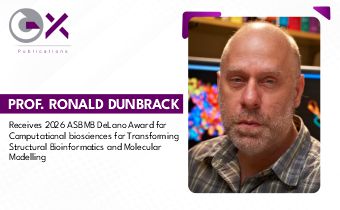
Prof. Roland L. Dunbrack Jr. has been named the recipient of the 2026 ASBMB DeLano Award for Computational Biosciences, one of the American society for Biochemistry and Molecular Biology’s highest honors recognising outstanding contributions to computational life sciences. Prof. Dunbrack’s groundbreaking efforts over decades in molecular modelling, structural bioinformatics and protein structure prediction have fundamentally changed the nature of biological investigation enabling rapid advances in therapeutic delivery.
Over the years, Prof. Dunbrack has had great impact on the field of structural bioinformatics, through his contributions to science by creating computational tools that make it easy for researchers to understand the protein folding and functioning. Through his scientific methods, he has been able to give the scientific community effective methods of modeling the structure of proteins. His contributions have become sources of foundational resources utilised by researchers within academia and biotechnology & pharmaceutical industries globally.
Prof. Dunbrack’s most influential work includes the backbone-dependent rotameter library, a major advance in molecular modelling for predicting where amino acids will favourably orient their side chains when placed into proteins. This breakthrough helped form the foundation of contemporary computational structural biology, underpinning advances and applications in protein structure prediction, protein engineering and rational drug design.
Prof. Dunbrack’s long range impact on computational biology is only now emerging. His methods have enabled scientists to probe protein dynamics with unmatched resolution, thus accelerating discoveries in cancer biology, molecular medicine and drug development. His computational models are included into numerous software platforms used in the biological sciences and have significantly improved the accuracy of structural studies.
Prof. Dunbrack is at the cutting edge of taking traditional structural bioinformatics techniques and precisely combining them with the production of new AI driven protein prediction technologies as artificial intelligence transforms biomedical research. Peter’s recent research interpreting thousands of experimentally obtained protein structures integrated with sophisticated computational models has enhanced the interpretational capability of scientists to comprehend the various forms proteins take and this is a step- change in efforts towards pharmacology. His research leads us through the ongoing development of computational biosciences with new technologies to tackle increasingly complex biological challenges.
Researchers whose computational advancements have greatly advanced molecular life sciences are recognized with the ASBMB DeLano Award. Named in memory of bioinformatics pioneer Warren L. DeLano , the award recognizes scientists who develop accessible and impactful computational technologies that enable groundbreaking biological discoveries. Prof Dunbrack’s selection reflects the profound and lasting influence of his research on structural biology , computational chemistry, and molecular medicine.
The recognition of Prof. Roland Dunbrack with the 2026 ASBMB DeLano award for Computational Biosciences celebrates a career dedicated to scientific innovation and excellence. His innovative work in the field of molecular modelling and structural bioinformatics has changed how scientists view proteins, design drugs and tackle biological systems. Prof. Dunbrack’s Research will endure as a continuing foundation for changes in the field, helping with discoveries that protect and enhance human health and allowing others working on life sciences exploration across the globe to innovate our future using computational technologies.