


Your voice decides what gets published.
GlobalX Publications connects academic voices worldwide through credible publishing, expert insights, and global research visibility.
GlobalX Publications
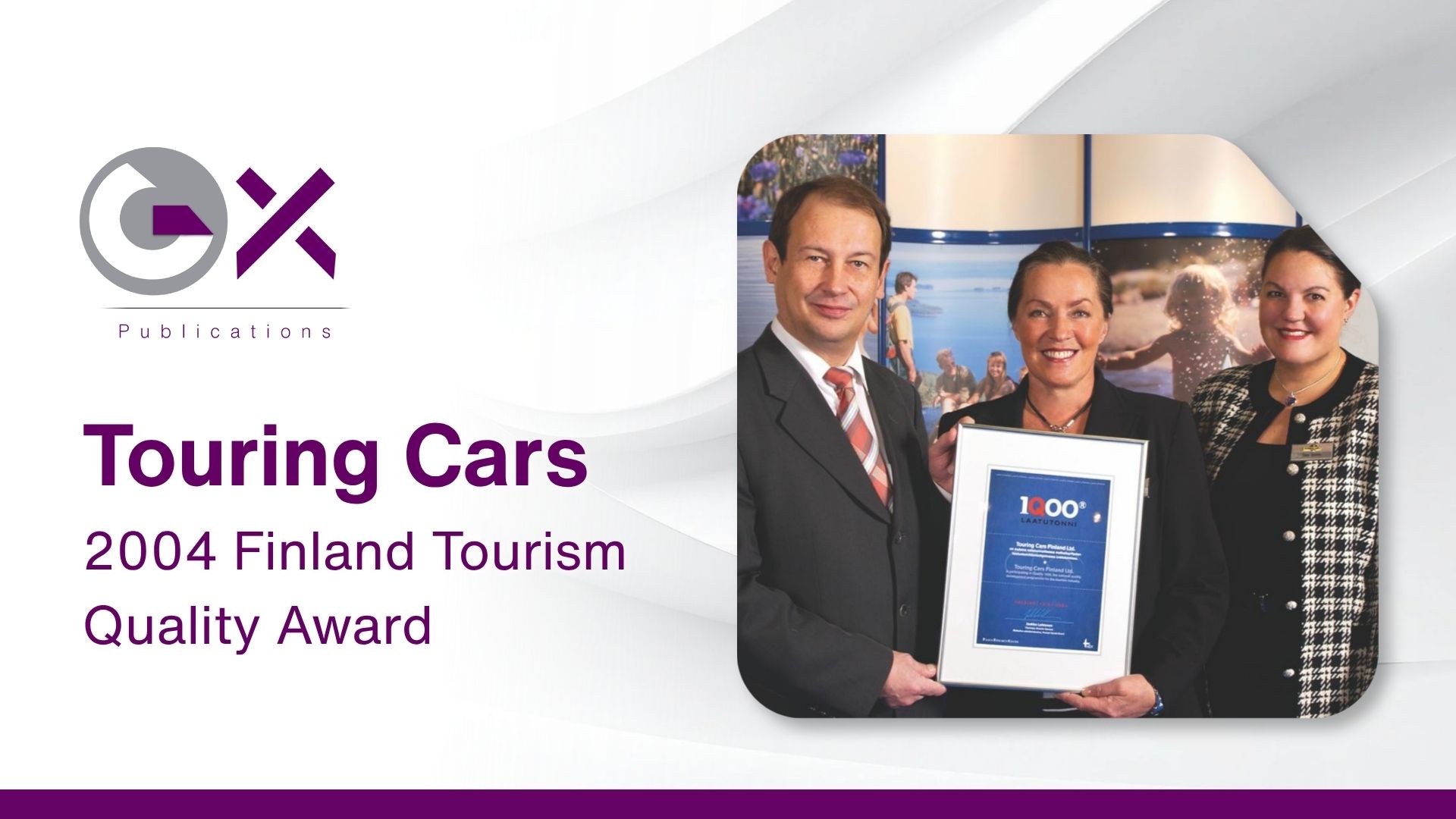
Looking back at Touring Cars’ 2004 Tourism Quality Award, which recognized its long-term commitment to quality management and customer service.
When a tourism company receives recognition for quality, the story is rarely about a single certificate. It usually reflects years of work behind the scenes: staff training, better processes, stronger customer care, and a clear focus on the visitor experience.
That is what makes the story of Touring Cars and its recognition by Finland’s tourism authorities worth revisiting. The company had already been building its position in Finnish motorhome tourism for years when quality management became a major part of its growth strategy.
One important clarification is needed. Touring Cars’ own history records that it received official praise from the Finnish Tourist Board in 2004, while historical academic material describes this as an honorary mention. The company’s actual Quality Award from the Finnish Tourist Board came in 2005.
Touring Cars was founded in Finland in 1982. Its origins were closely connected to the growing idea of motorhome travel in a country where this type of tourism was still relatively uncommon.
The company’s early development was strongly linked to understanding what travelers needed from a motorhome holiday. By the 1990s, Touring Cars was investing in its fleet, expanding its operations, and placing greater emphasis on customer service.
This focus became even more important in the early 2000s. According to the company’s historical account, Touring Cars introduced a staff training program and a quality handbook in 2002. These were practical steps toward creating more consistent service standards.
For a Motorhome Rental Finland business, this matters. Customers are trusting a company with an important part of their holiday. Vehicle condition, booking information, handover procedures, staff knowledge, and support can all shape the experience.
Touring Cars joined the Laatutonni, or Quality Thousand Program, associated with the Finnish Tourist Board, known at the time as MEK. The program was designed specifically for tourism businesses and focused on practical quality development.
Laatutonni was not simply about presenting a high-quality image. Its approach connected quality with everyday operations. Training, self-assessment, customer feedback, staff development, and systematic improvement were important parts of the process. Academic research on the program also describes its use of quality-prize criteria and structured self-assessment.
This provides useful context for understanding Touring Cars’ recognition. Quality Management in tourism is often invisible to customers when it works well. A traveler may only notice that the booking is clear, the vehicle is ready, staff know what they are doing, and problems are handled quickly.
That is the practical meaning of Customer Service Excellence.
The year 2004 was an important stage in Touring Cars History.
The company expanded its activities by opening offices in Kuopio, Pori, and Oulu. At the same time, it received official praise from the Finnish Tourist BoardAccording to the company's past records, Dun & Bradstreet also awarded Touring Cars a AAA credit rating that year.
A Finnish tourism industry thesis provides additional historical confirmation. It records that Touring Cars received an honorary mention from the Finnish tourism promotion authority in 2004 and later became Finland’s most innovative tourism company in 2005.
This distinction is important when discussing the 2004 Tourism Quality Award. Rather than treating 2004 and 2005 as the same recognition, the available historical evidence suggests a progression: official recognition in 2004 followed by the Finnish Tourist Board’s Quality Award in 2005.
The recognition came during a period when Finnish tourism businesses were paying increasing attention to structured quality systems.
The Finnish Tourist Board’s own guidance explained that tourism quality was not simply about luxury or expensive facilities. It included functionality, cleanliness, value for money, and the ability to deliver on promises made to customers.
That principle fits Touring Cars particularly well.
A motorhome holiday depends on many small details working together. A clean vehicle, accurate instructions, helpful staff, reliable equipment, and effective communication can turn a complicated rental process into a comfortable travel experience.
Touring Cars’ participation in Laatutonni therefore showed that quality was being treated as an operating discipline rather than just a marketing message.
The Touring Cars example offers several useful lessons for the Tourism Industry Finland and for tourism businesses more broadly.
First, quality starts internally. Staff training and clear procedures can have a direct effect on customer experience.
Second, quality should be measurable. Programs such as Laatutonni encouraged businesses to examine their own operations instead of relying only on assumptions.
Third, recognition follows consistent work. Awards are more meaningful when they reflect systems that have already been built into daily operations.
Finally, customer experience is the real test. Tourism businesses operate in an environment where customers remember how they were treated just as much as what they purchased.
The story of Touring Cars shows how Finnish Tourism History connects business growth with systematic quality development. Its journey from a Finnish motorhome pioneer to an internationally operating tourism company was supported by investment in people, processes, products, and customer service.
The 2004 recognition should therefore be viewed as part of a larger quality journey, not as an isolated achievement. The stronger historical record points to official praise in 2004 and the Finnish Tourist Board’s Quality Award in 2005.
For today's tourism businesses, the lesson remains relevant: quality is not created by an award. The award is a reflection of the systems, people, and customer experiences built before it.