



Your voice decides what gets published.
GlobalX Publications connects academic voices worldwide through credible publishing, expert insights, and global research visibility.
John Fedrick
The European Society of Biomechanics awards the 2025 Best Doctoral Thesis in Biomechanics to Dr. Apeksha Shapeti for groundbreaking research on force-mediated angiogenesis and vascular lesion growth.
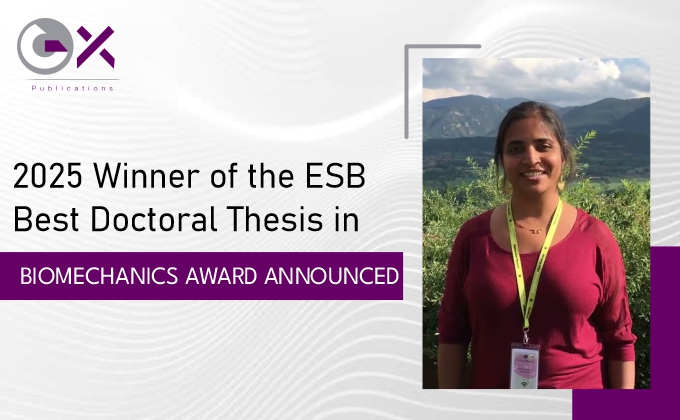
The European Society of Biomechanics (ESB) has also awarded the 2025 Best Doctoral Thesis in Biomechanics Award, in recognition of an outstanding doctoral research that provides new contributions to the theory and practice of biomechanics. It is a research award that recognizes years of outstanding scientific work and innovativeness of early-career scientists in this interdisciplinary field of science.
Every two years the Best Doctoral Thesis in Biomechanics Award is given at the ESB Congress to a doctoral student who has authored a thesis that has made an outstanding contribution to the science of biomechanics. Admissible dissertations are in English, undergo scientific rigor, originality and contribution to theory/ practice in biomechanics. Besides academic status, the award will provide a forum through which the recipient will be able to present his/her work in a plenary session at the ESB Congress.
The 2025 version of this award was presented at the 30th ESB Congress, which was hosted in Zurich, Switzerland, and the nominations were of high quality with a wide international and scientific spread of the scholarship of biomechanics research. The winner was chosen by the ESB Awards Committee after a review of outstanding doctoral theses to Dr. Apeksha Shapeti, of KU Leuven, Belgium which was titled " Force-Mediated Angiogenesis: Linking Mechanical Mechanisms to Vascular Lesion Growth.
The work of Dr. Shapeti provides an extensive study of how mechanical forces play a role in the development of blood vessels and in the development of vascular lesions. Through the combination of innovative biomechanical modeling research and experimental research, her work contributes to the understanding of mechanobiological processes that may be applied to the knowledge about vascular disease and treatment methods. The prize reflects the increased acknowledgment of interdisciplinary methods that bring together mechanics, biology, and clinical topography in the current research in biomechanics.
Other candidates that made it to the finals were Elena Redaelli of the University of Zaragoza (Spain) and other prominent doctoral students whose research also proved to make valuable contributions to the science of biomechanics.
Along with a certificate and acknowledgment during the ESB Congress, the work by Dr. Shapeti will also be widely circulated in ESB publications, and it is not likely that the intended work will fail to stimulate further studies in the field of mechanobiology and its related disciplines. The award does not just honor individual merit, but it also illuminates the energy of doctoral research in meeting complicated problems at the interplay of engineering, life sciences and medicine.
The European Society of Biomechanics hereby congrats Dr. Apeksha Shapeti and all the nominees on their remarkable contribution to the scientific community and the society is determined to promote the development of biomechanical information and support the future generation of scientists.