


Your voice decides what gets published.
GlobalX Publications connects academic voices worldwide through credible publishing, expert insights, and global research visibility.
GlobalX Publications
Northwestern professor Uri Wilensky wins the 2025 Yidan Prize for Education Research for pioneering agent-based modeling and advancing computer-based learning.
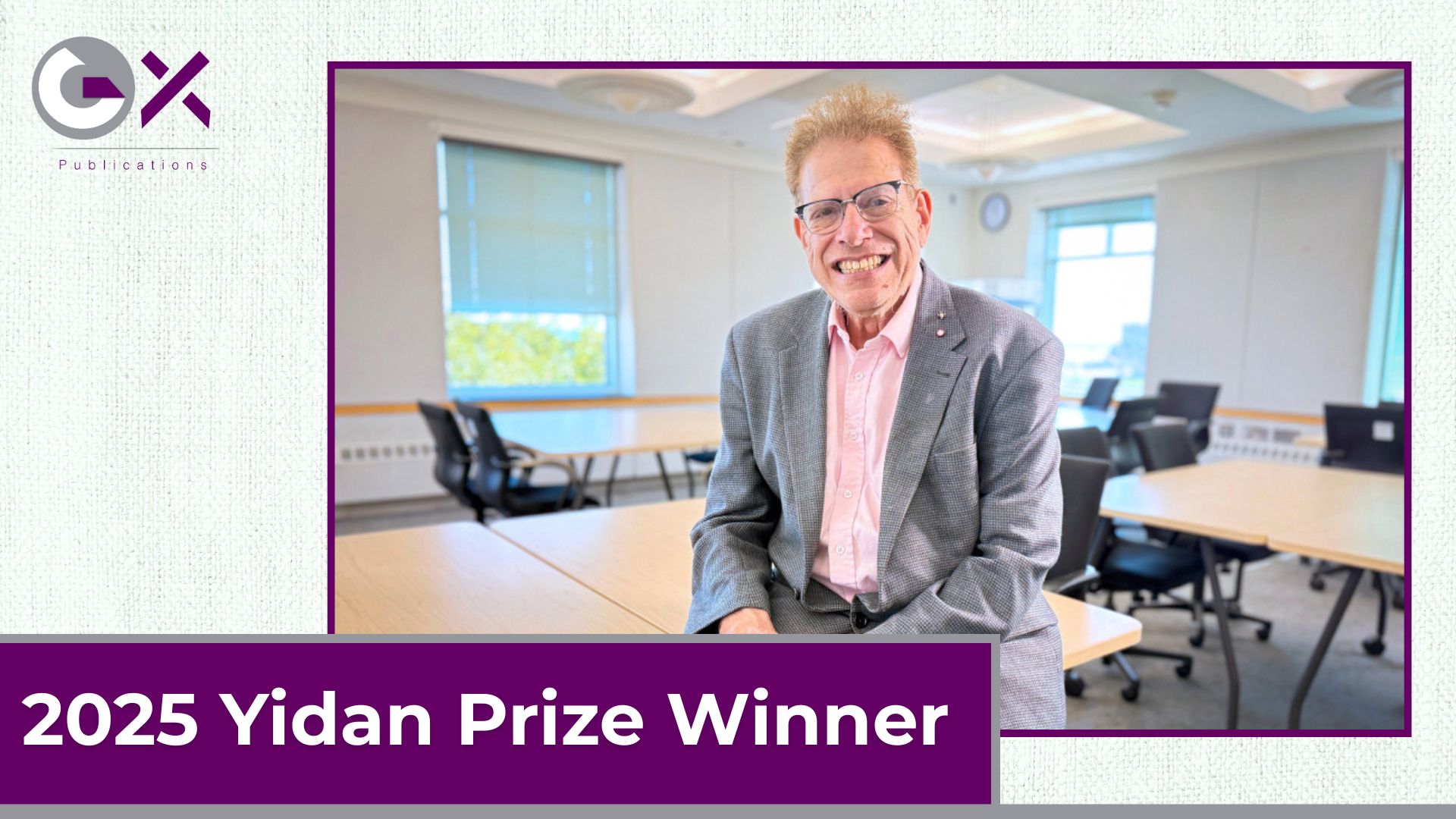
Uri Wilensky, a prominent computer modeling and education researcher at Northwestern University is the winner of the 2025 Yidan Prize of Education Research. The Yidan Prize, the largest education award in the world, is a recognition of individuals that have made an innovative contribution in the field of learning and teaching around the world.
Wilensky, an appointee of both the School of Education and Social Policy (SESP) and the McCormick School of Engineering and Applied science, at Northwestern was known to have pioneered agent-based modeling (ABM)- a technique that has aided learners to comprehend complex systems, including climate change, pandemics, and economic behavior.
The award comes with a funding of 3.8 million half of which will be utilized in further studies by Wilensky in increasing access to computational modeling education across the world.
For over three decades, Uri Wilensky has championed the use of computer simulations to improve scientific and social understanding. In 1999, he created NetLogo, a free, open-source platform that allows users—from students to researchers—to build models demonstrating how individual agents interact to produce large-scale outcomes.
“NetLogo helps people grasp how small changes in behavior can influence larger systems,” Wilensky explained. “My goal is to make agent-based modeling a universal literacy, empowering individuals and organizations to better understand the complex world they live in.”
Through NetLogo, Wilensky has democratized access to computational tools that once required advanced programming skills, enabling educators, policymakers, and students to engage directly with real-world problems.
According to Andreas Schleicher, head of the Yidan Prize Education Research judging panel, Wilensky’s work represents “a critical step in preparing learners for the challenges of a data-driven, interconnected world.” Schleicher praised Wilensky for equipping students with tools that “foster confidence and agency to navigate nonlinear, complex systems.”
Wilensky’s research, which bridges learning sciences, computer science, and complexity theory, has redefined how interdisciplinary learning can occur. His work has influenced curriculum design, teacher training, and educational technology worldwide.
As the founding director of the Northwestern Center for Connected Learning and Computer-Based Modeling, Wilensky has mentored generations of scholars who now hold academic positions across the globe. His extensive body of work includes over 400 computational models for education, numerous scholarly publications, and the widely acclaimed book An Introduction to Agent-Based Modeling.
“Uri Wilensky’s impact extends far beyond Northwestern,” said Bryan McKinley Jones Brayboy, Dean of SESP. “His work has made complex ideas accessible to everyone, transforming how we teach, learn, and think about the world.”
Christopher Schuh, Dean of the McCormick School of Engineering, added, “Wilensky has not only advanced computer science and modeling but has revolutionized education itself through interdisciplinary innovation.”
Wilensky intends to integrate NetLogo further in academic centres, research projects, and in society around the world, with the help of the Yidan Prize 2025. He envisages to develop the problem of agent-based modeling literacy so that the generations to come are in a position to analyze and solve the tricky international issues.
Education, Wilensky thought, is the ability to perceive the invisible patterns that we live in. That is what modeling can do.