






Science education should encourage every learner to ask questions, investigate evidence, conduct experiments, and understand the world around them. Yet for many students with disabilities, the biggest challenge is not understanding science. It is gaining equal access to the way science is taught.
A laboratory bench may be difficult to access. A diagram may not work for a student with a visual disability. A long scientific text may create unnecessary barriers for a learner with a specific learning difficulty. A practical assessment may measure physical speed or handwriting rather than scientific understanding.
These challenges raise an important question: How can schools make science genuinely accessible without lowering academic expectations?
This is the central concern behind modern approaches to Science Education for Students with Disabilities.
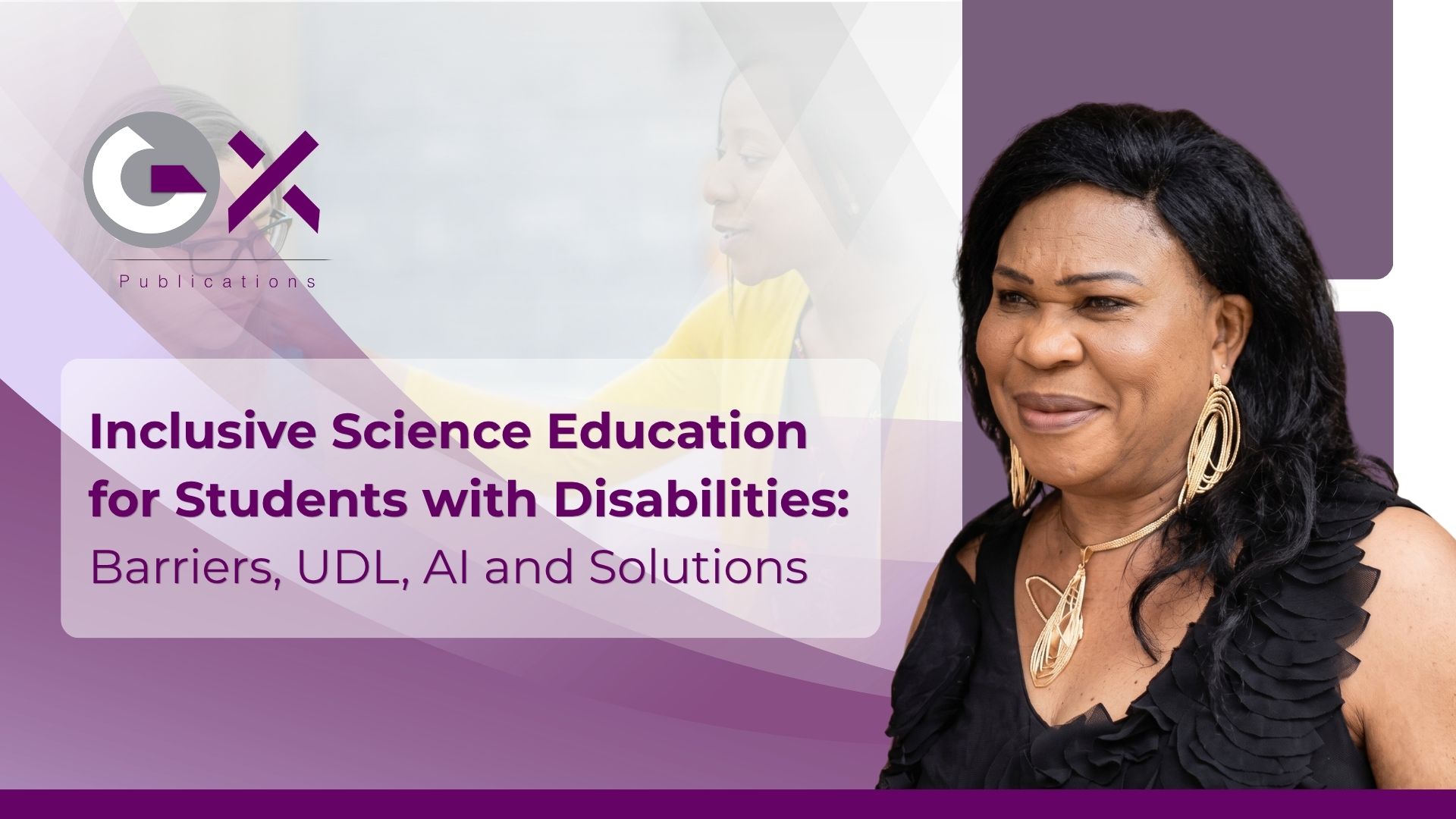
One particularly relevant body of research comes from AMB.Prof.Dr. Princess Victoria G. Isaac, an educator, researcher, and advocate for inclusive science education. Her doctoral research, completed in 2025, examined barriers experienced by students with disabilities in science education and explored how inclusive curriculum design, teacher training, accessible resources, and Universal Design for Learning (UDL) can improve educational outcomes.
Her research is particularly valuable because it connects academic study with extensive classroom and leadership experience in science education.
A Research-Based Perspective: The Work of Princess Victoria G. Isaac
AMB.Prof.Dr. Princess Victoria G. Isaac brings more than two decades of experience across science teaching, curriculum leadership, assessment, quality assurance, and SEND provision.
Her professional background includes teaching Biology, Physics, and Chemistry in London schools. She has also worked as an AQA Moderator, Edexcel Senior Verifier and Lead Internal Verifier, and has mentored more than 50 trainee and early-career teachers.
This practical background gives her doctoral research an important classroom perspective.
Her dissertation focuses on a problem that teachers regularly encounter: students with disabilities can face barriers in science even when they have the intellectual ability and motivation to succeed.
The research examines several connected areas:
- Barriers experienced by students with disabilities in science education
- Inclusive curriculum design
- Teacher preparation and professional development
- Accessible learning resources
- Universal Design for Learning
- More inclusive approaches to science teaching and learning
The significance of this work is that it moves the discussion away from the idea that the student is the problem.
Instead, it asks whether the curriculum, teaching method, learning environment, resources, and assessment system are creating unnecessary barriers.
That distinction is important.
If a student understands a scientific concept but cannot access the diagram used to explain it, the problem may not be the student's scientific ability. The problem may be the format in which the information was provided.
View AMB.Prof.Dr. Princess Victoria G. Isaac's Research Profile and Dissertation
What Her Research Means for Inclusive Science Education
The work of Princess Victoria G. Isaac provides a useful framework for understanding why Accessible Science Education requires more than individual accommodations.
A teacher may provide extra time to one student or modify one laboratory activity. Those adjustments can be important, but they do not automatically make the wider curriculum accessible.
A stronger approach is to consider accessibility while the lesson is being designed.
For example, when preparing a lesson on ecosystems, a teacher could provide:
- A readable text explanation
- A labeled visual diagram
- A verbal explanation
- An accessible digital resource
- A physical or tactile model where appropriate
- Key vocabulary before the lesson
- Multiple ways for students to demonstrate understanding
The scientific standard remains the same.
What changes is the number of routes available to reach it.
This principle is closely connected with Universal Design for Learning.
Universal Design for Learning in Science Education
UDL is based on the idea that learner differences should be anticipated during lesson design rather than treated as unexpected problems.
CAST's UDL framework focuses on three broad areas:
- Engagement: providing different ways for learners to participate and remain motivated.
- Representation: providing information in different accessible forms.
- Action and expression: providing different ways for students to demonstrate what they know.
These principles have direct relevance to UDL in Science Education.
Consider a lesson about the human heart.
A traditional lesson might rely heavily on a textbook diagram and teacher explanation.
A UDL-based lesson could combine:
- An accessible diagram
- A physical model
- Animation
- Spoken explanation
- Captioned video
- Key vocabulary
- A structured activity
- A choice of assessment formats
The objective is still to understand the structure and function of the heart.
The difference is that students are not forced to rely on one method of receiving information.
The Barriers Students With Disabilities Can Face
The research focus identified in Princess Victoria G. Isaac's doctoral work reflects a wider issue within science education.
Physical barriers
Science laboratories can be difficult environments for students with physical disabilities.
Equipment may be positioned at inaccessible heights. Some experiments require fine motor movements. Safety procedures may rely on visual or auditory signals.
Schools can respond by reviewing laboratory layouts, adapting equipment, using accessible digital simulations where appropriate, and ensuring students have meaningful roles during practical investigations.
Sensory barriers
Students with visual or hearing disabilities may encounter barriers when science content is delivered through only one sensory channel.
A video without captions excludes some learners.
A complex diagram without an accessible alternative can exclude others.
Teachers should consider captions, transcripts, audio descriptions, tactile resources, large-print materials, screen-reader-compatible documents, and other appropriate accessibility tools.
Cognitive and learning barriers
Scientific subjects contain specialist vocabulary and complex concepts.
Students with dyslexia, ADHD, autism, or other learning needs may benefit from clearer structure, chunked instructions, visual organization, explicit vocabulary teaching, predictable routines, and opportunities to revisit information.
These strategies are not about making science easier.
They are about making the route into complex scientific thinking clearer.
Why Teacher Training Matters
One of the most important lessons from inclusive science research is that accessibility cannot depend entirely on goodwill or individual creativity.
Teachers need knowledge and training.
A science teacher may understand chemistry extremely well but have limited preparation in:
- Disability inclusion
- SEND provision
- Accessible assessment
- Assistive technology
- UDL
- Accessible laboratory design
- Differentiated instruction
- Inclusive curriculum planning
This is why teacher development must be part of any serious strategy for Disability Inclusion.
Princess Victoria G. Isaac's professional experience is particularly relevant here because her career has included science teaching, curriculum leadership, assessment, quality assurance, and teacher mentoring. Her profile records experience mentoring more than 50 trainee and early-career teachers.
This combination of classroom practice, assessment experience, and doctoral research illustrates why inclusive science education requires both subject expertise and inclusive teaching expertise.
Assistive Technology Can Expand Access
Assistive Technology can help remove specific barriers.
Depending on the student's needs, useful tools may include:
- Screen readers
- Text-to-speech
- Speech-to-text
- Captioning
- Magnification
- Alternative keyboards
- Accessible simulations
- Digital graphic organizers
- Tactile models
- Accessible data-analysis tools
However, technology should solve a learning problem rather than simply being added because it is available.
A digital textbook is not automatically accessible.
An online laboratory is not automatically inclusive.
The technology must be compatible with the student's needs and with the learning objective.
AI in Education: A New Opportunity, With Limits
AI in Education may also support inclusive science teaching.
Teachers can use carefully reviewed AI tools to create alternative explanations of difficult concepts, generate practice questions, produce vocabulary support, structure lesson materials, and develop different examples of the same scientific idea.
For instance, a teacher introducing Newton's laws might provide:
- A technical explanation
- A simple everyday example
- A step-by-step problem
- A visual explanation
- Additional practice questions
- Vocabulary support
AI can help produce these variations more efficiently.
But AI should not replace professional judgment.
AI-generated explanations may contain factual errors. They can also reproduce bias or produce content that is not accessible to a particular learner.
The teacher remains responsible for checking accuracy, appropriateness, accessibility, and alignment with the curriculum.
A Practical Example From the Science Classroom
Imagine a biology lesson where students investigate plant growth.
The traditional activity asks students to measure plants, record results, produce a graph, and write a conclusion.
An inclusive classroom could maintain exactly the same scientific objectives while changing how students access and demonstrate the learning.
The teacher could provide:
- A clearly structured investigation sheet.
- A demonstration before students begin.
- Captioned instructional material.
- A visual step-by-step procedure.
- Adapted measuring equipment where required.
- Speech-to-text for students who need it.
- An accessible digital spreadsheet.
- Different ways to present the final findings.
A student who has difficulty writing by hand could still demonstrate accurate scientific reasoning.
A student with a visual impairment could work with accessible data and an appropriate tactile or digital representation.
A student who struggles with dense written instructions could follow a structured visual procedure.
The scientific expectations remain high.
The barriers are reduced.
From Accommodation to Inclusive Design
This distinction is one of the most important lessons for schools.
Accommodation asks:
What adjustment does this particular student need?
Inclusive design asks:
How can we design the learning environment so that fewer unnecessary barriers exist in the first place?
Both approaches have a place.
Individual accommodations remain essential for many learners. But UDL encourages educators to think further upstream.
Instead of designing a lesson for an imagined "average" learner and then modifying it, teachers can begin by recognizing that classrooms naturally contain different ways of learning, communicating, moving, processing information, and demonstrating knowledge.
This is the foundation of stronger Inclusive Classrooms.
What Schools Can Learn From This Research
The work of Princess Victoria G. Isaac points toward a broader lesson for schools and science departments.
Inclusive science education should be approached as a whole-school responsibility.
Review the curriculum
Identify where students are expected to rely on one particular method of accessing information.
Review laboratory access
Consider physical access, equipment, safety procedures, and meaningful participation.
Review assessment
Ask whether assessments measure the intended scientific knowledge or unintentionally measure unrelated skills.
Improve teacher training
Professional development should include UDL, SEND, accessibility, assistive technology, and responsible use of AI.
Listen to students
Students with disabilities understand barriers in ways that staff may not always see.
Their experiences should inform decisions about curriculum, technology, assessment, and classroom practice.
The Future of Inclusive STEM Education
The future of STEM Education should not be about creating separate science for students with disabilities.
- It should be about designing science education that recognizes learner diversity from the beginning.
- UDL can provide the design framework.
- Assistive technology can provide individual support.
- Educational technology can expand access to content and experimentation.
- AI may provide additional flexibility and personalization.
- Teacher expertise connects all of these tools to meaningful learning.
The research and professional experience of AMB.Prof.Dr. Princess Victoria G. Isaac provide a useful example of why this work needs to be grounded in both research and classroom reality. Her doctoral research directly addresses barriers in science education and connects them with inclusive curriculum design, teacher training, accessible resources, and UDL.
Her work also reinforces an important point: inclusion is not simply about placing students with disabilities in mainstream science classrooms.
True inclusion means giving them a genuine opportunity to participate, investigate, communicate, achieve, and see themselves as capable science learners.
Conclusion
Science Education for Students with Disabilities is not a question of lowering standards.
It is a question of removing unnecessary barriers to high standards.
The research of AMB.Prof.Dr. Princess Victoria G. Isaac adds an important practical and scholarly perspective to this conversation. With extensive experience in science education, curriculum development, assessment, SEND provision, and teacher development, her doctoral research examines the barriers that students with disabilities can face and the role that inclusive curriculum design, accessible resources, teacher preparation, and Universal Design for Learning can play in addressing them.
The wider lesson is clear.
A science classroom becomes more inclusive when accessibility is considered before the lesson begins, not after a student encounters a barrier.
UDL can help teachers plan for learner variability. Assistive Technology can provide targeted support. AI and other forms of Educational Technology may expand the ways students access and express knowledge when used responsibly.
Most importantly, inclusion must remain connected to good teaching.
Students with disabilities should not have to prove that they can overcome an inaccessible system before they are given the opportunity to learn science.
The goal should be simpler: design science education so that more students can enter, participate, investigate, and succeed from the beginning.


Comments (0)
No comments yet. Be the first to share your thoughts!
Leave a Reply
Your email address will not be published. Required fields are marked *