


Your voice decides what gets published.
GlobalX Publications connects academic voices worldwide through credible publishing, expert insights, and global research visibility.
GlobalX Publications
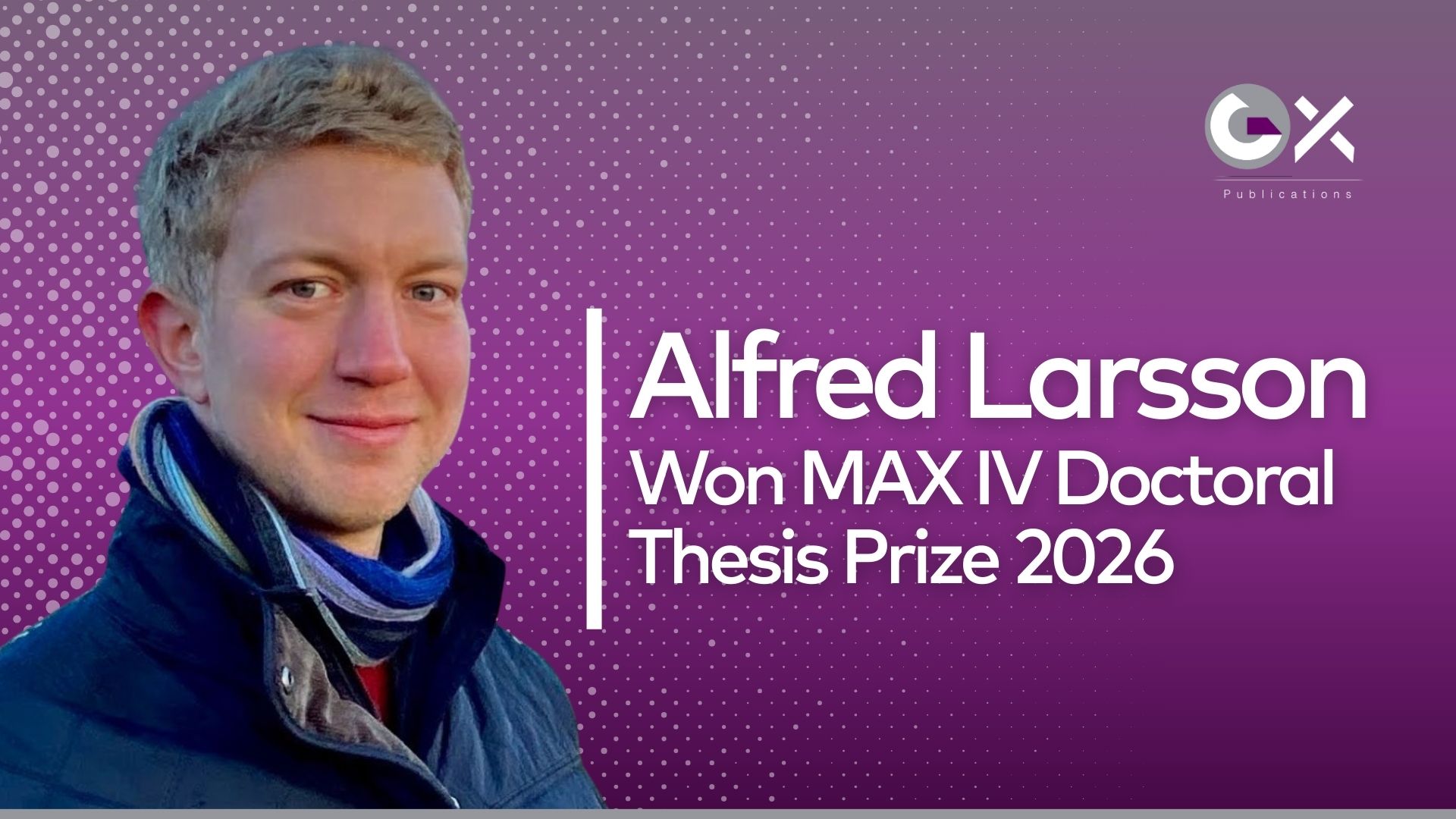
Alfred Larsson is a winner of the MAX IV Doctoral Thesis Prize 2026 which is a research award honoring excellent scholarship made by a doctoral student performed relating to the MAX IV Laboratory. The award is in recognition of the academic achievement of Larsson in the field of advanced materials and synchrotron radiation studies, which reflects the significance of doctoral recognition in propelling the worldwide research contributions in the fields of physics, chemistry, and materials science.
The MAX IV Doctoral Thesis Prize is awarded to a researcher every year based on the presentation of dissertation that portrays methodological rigor, originality and quantifiable scientific relevance. The recognition of Larsson demonstrates the achievement of excellent academic results in the field of experimental design and the use of high-brilliance of synchrotron light to answer complicated scientific questions.
The MAX IV Laboratory in Lund, Sweden was the national synchrotron radiation facility in Sweden and among the most sophisticated light sources worldwide. The laboratory functions in close collaboration with Lund University and is used in multidisciplinary research in the structural biology of cells, nanotechnology, materials science, chemistry, and environmental science.
The infrastructure of the MAX IV allows the researcher to study the structure of atoms and molecules at an extreme level of accuracy. Experiments involving doctoral candidates at the facility are frequently done on special beamlines which are fitted with equipment to investigate electronic structure, chemical reactions, and phenomena at the nanoscale.
The Doctoral Thesis Prize is a research award and at the same time it is an indicator of institutional commitment to academic excellence even in the early career of large-scale scientific infrastructures.
The doctoral work centered on novel methods of characterizing advanced materials in a dynamic condition by using synchrotron radiation. These studies usually entail the use of spectroscopy, diffraction as well as imaging to comprehend the behavior of materials at atomic scales.
These insights are essential in designing materials research in the present-day materials research to create sustainable energy systems, high-performance electronics, and environmentally responsive materials. Using the potential of the beamlines of MAX IV, the dissertation by Larsson provided both technical innovation and interdisciplinary collaboration which are usually regarded as important factors when considering doctoral recognition activities.
As the main strengths of the thesis, the committee in charge of the award noted the transparency of scientific argumentation, sound data interpretation, and reproducibility of the experimentation techniques. These aspects are very close to the international requirements of scholarly contribution in major research institutions.
After being reviewed and assessed internally, the MAX IV Doctoral Thesis Prize is given. The criteria normally cover originality, scientific rigor, publication record based on the thesis, and the greater applicability of the findings.
Doctoral projects often include interdisciplinary and interinstitutional collaboration in large-scale research facilities like synchrotron facilities. Such a research award is recognition that not only has a particular researcher succeeded, but also the robustness of scientific ecosystems in collaboration.
In a formal announcement that was made with the announcement, Larsson stated:
I had an opportunity to complete a doctoral study at MAX IV, which offered access to the best stationary equipment and the shared expertise. Such acknowledgment is an indicator of the overall contribution of the supervisors, beamline scientists and research partners to the project.
These comments are indicative of the cooperative spirit of large research facilities, where academic performance is usually a matter of interdisciplinary cooperation.
Doctoral status in high-tech research institutes has more than just personal career implications. Investigations with the help of synchrotrons are used in the development of renewable energy materials, pharmaceuticals, advanced production, and environmental monitoring.
Doctoral work at such facilities as MAX IV contributes to the global scientific community by developing a methodology and deepening the understanding of the nature of materials behavior. Findings are often shared in peer-reviewed journals and other research projects in partnership with other countries, enhancing the position of Europe in the research infrastructure of the world.
Moreover, the acknowledgement of young scientists can provide academic sustainability through increased commitment to intricate scientific issues. In a world where technological change is swiftly taking place, the continued investment in research at the doctoral level is crucial to the innovation ecosystems of the world.
The example of Alfred Larsson being given the MAX IV Doctoral Thesis Prize 2026 is a further way doctoral recognition can help sustain high levels of scholarly contribution in the higher research setting.
This type of prize is becoming increasingly important as research infrastructures continue to become more intercontinentally connected, and the importance of high-quality doctoral education, methodological, and collaborative inquiry is emphasized by the prize. Not only does the award provide recognition of individual achievement, it also strengthens the institutional structures that make scientific discovery on a large scale possible.
By further focusing on research award schemes and open assessment and evaluation procedures, such institutions as MAX IV Laboratory and Lund University contribute to the development of a culture of research in the world based on academic high standards and quantifiable social impact.
Source: Governmental official statement or nomination.