


Your voice decides what gets published.
GlobalX Publications connects academic voices worldwide through credible publishing, expert insights, and global research visibility.
GlobalX Publications
Dr. Graeme Segal has been named a recipient of the Chern Medal 2026, recognising his lifelong contributions to mathematics, algebraic topology, and mathematical physics.
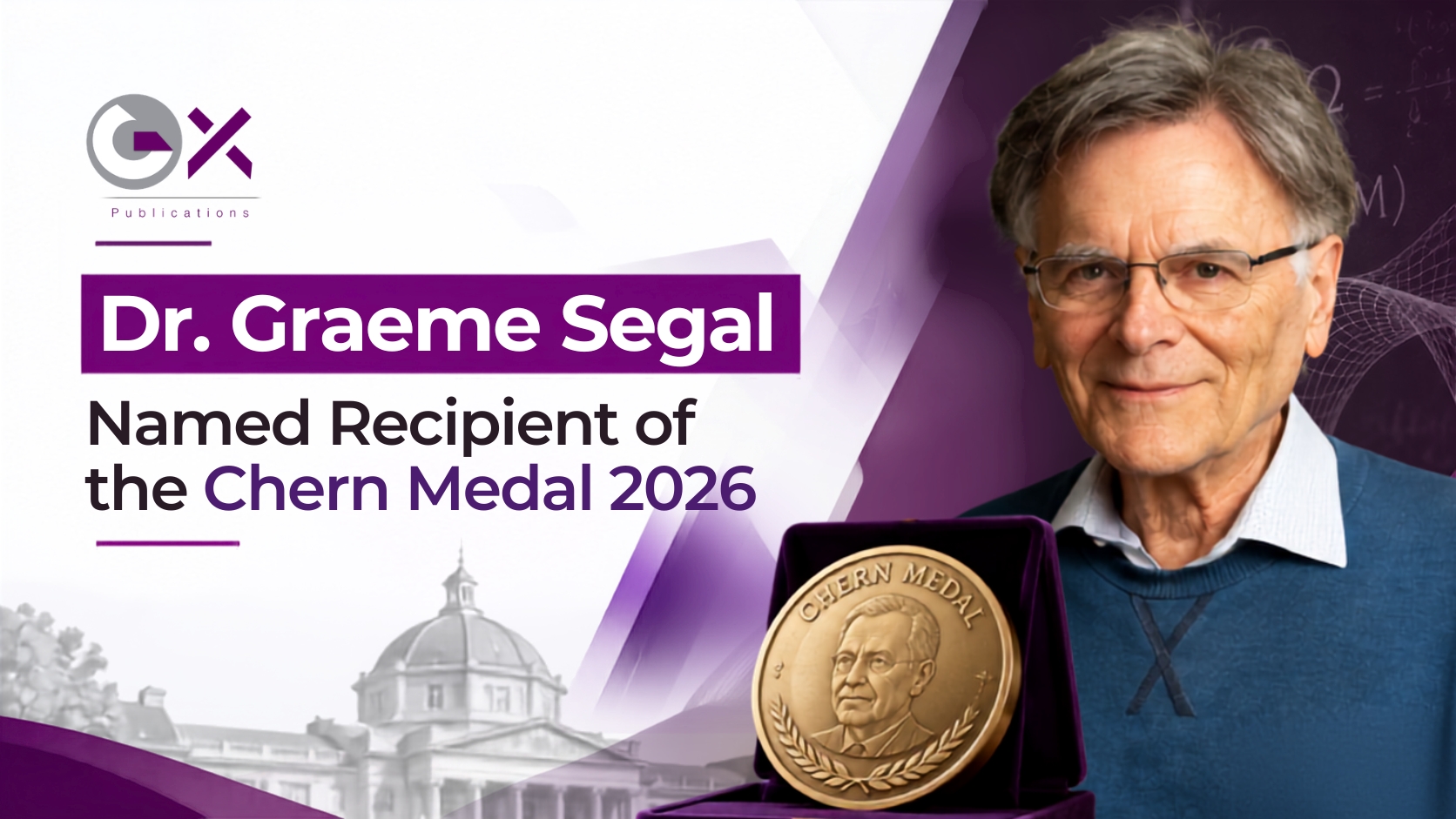
Dr. Graeme Segal has been awarded the Chern Medal 2026 for a lifetime of influential contributions to mathematics and mathematical physics. The International Mathematical Union (IMU) announced the honour during the opening ceremony of the International Congress of Mathematicians (ICM) 2026 in Philadelphia on July 23.
The Chern Medal is awarded every four years to recognise an individual whose accomplishments represent an outstanding achievement in mathematics. Named after renowned mathematician Shiing-Shen Chern, the medal is regarded as one of the highest international honours for a lifetime of mathematical achievement.
For Graeme Segal, the 2026 recognition reflects the broad and lasting influence of his work across several areas of modern mathematical research. The IMU recognised his “visionary mathematical insights” and their enduring impact on topology, mathematical physics, representation theory and category theory.
Segal's early research established important foundations in algebraic topology, particularly in homotopy theory. His work contributed to the development of mathematical frameworks that have influenced subsequent research in topology and related disciplines.
His career has also demonstrated how ideas originating in pure mathematics can connect with questions arising in physics. This interdisciplinary approach has become an important feature of his mathematical legacy, particularly through his research connected with quantum field theory and string theory.
One of the defining aspects of Graeme Segal's research has been his contribution to the mathematical understanding of quantum field theory. His axiomatic approach helped provide a rigorous mathematical framework for concepts originating in theoretical physics.
This work contributed to stronger connections between mathematics and physics, influencing research in mathematical physics and providing ideas that have subsequently been developed across areas including topology, representation theory and category theory. Segal's work illustrates the increasingly important role of mathematical structures in understanding fundamental physical theories.
Born in Australia, Segal studied in Sydney before continuing his education at the University of Cambridge and the University of Oxford. He later held senior academic positions at Cambridge and Oxford and is now an Emeritus Fellow of All Souls College, Oxford. He is also a Fellow of the Royal Society and previously served as President of the London Mathematical Society.
The Chern Medal 2026 adds to a distinguished list of honours. Segal received the London Mathematical Society's Pólya Prize and the Royal Society's Sylvester Medal for mathematical research in 2010.
The recognition of Dr. Graeme Segal highlights the continuing importance of mathematical research that crosses traditional disciplinary boundaries. His career demonstrates how developments in topology, geometry and abstract mathematical structures can contribute to broader understanding in theoretical physics.
The Graeme Segal Chern Medal recognition therefore represents not only a major mathematics award 2026, but also a celebration of sustained intellectual contribution to mathematics, mathematical physics and the connections between fundamental mathematical ideas and modern science.